Instead of Sitting in a Classroom All Day, What If Students Built Their Own Business?

What if preparing students for university was not only about getting good grades?

What if, instead of spending every day sitting in a classroom, students could also spend their time building something real?

A business.

A project.

A community.

A personal portfolio.

Or an idea that started as a simple conversation and eventually became something people actually use.

This is one of the ideas behind JA College, a university preparation programme in Indonesia that looks beyond academic preparation. While students can pursue recognised university pathway programmes such as A Level and Foundation, JA College also believes that preparing students for university means preparing them for the realities of life beyond the classroom.

And one example of this philosophy can be found in a simple coffee shop created by students themselves.

Meet the Students Behind Teman Siang

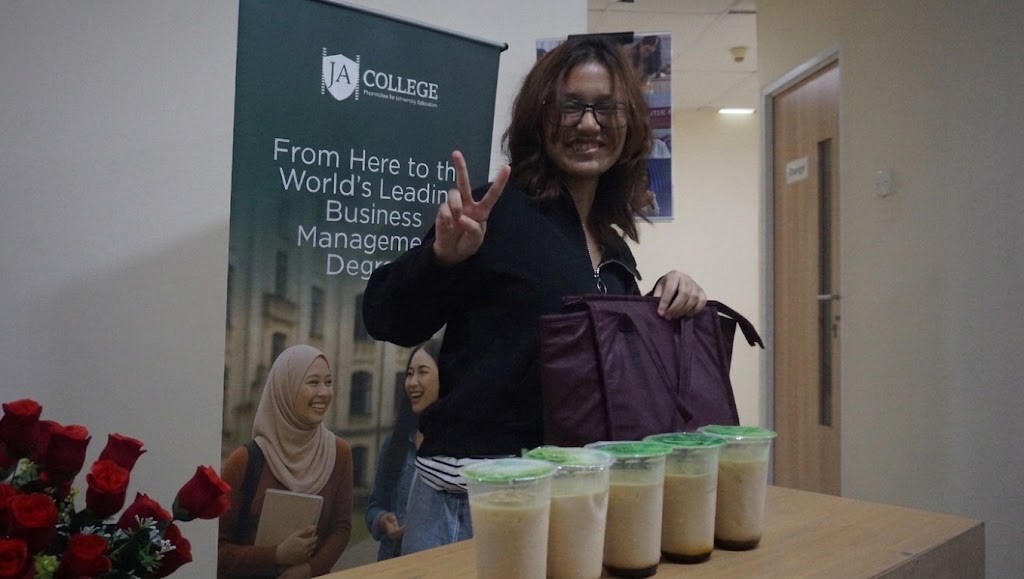
Meet the founders of Teman Siang, a coffee shop created by JA College students.

At first, they may look like ordinary students.

They attend classes.

They study.

They complete their assignments.

They prepare for university.

But they also decided to do something different.

Before even graduating, they wanted to build something of their own.

That decision turned an idea into a real-world learning experience.

Running a small business requires students to think beyond textbooks. They have to communicate with people, make decisions, solve problems, manage their time, understand customers, work with others, and deal with situations that cannot always be answered by a textbook.

And sometimes, business does not wait until after graduation.

What If University Preparation Meant More Than Academics?

When parents think about university preparation, they often focus on academic qualifications.

That makes sense.

Strong academic preparation is important, particularly for students planning to study internationally. Programmes such as A Level and Foundation can provide students with the academic foundation needed to progress to university.

JA College offers university pathway programmes designed to prepare students for international higher education, including Foundation and A Level pathways. (jacollege.com)

But getting into university is only one part of the journey.

What happens after students arrive?

Can they communicate confidently with people from different backgrounds?

Can they manage their time without someone constantly reminding them?

Can they deal with academic pressure?

Can they make friends?

Can they adapt when things do not go according to plan?

Can they solve problems independently?

These questions become particularly important for students who plan to study abroad.

Research on Indonesian students studying overseas has identified challenges including language and communication barriers, academic adjustment, social integration, and cultural differences. (ijebp.ejournal.unri.ac.id)

That is why university preparation should not stop at academic preparation.

University Is Not Just a Bigger Classroom

One of the biggest changes students experience when they move abroad is the level of independence.

In school, there are often teachers, parents, schedules, and systems that help students stay on track.

At university, particularly when studying overseas, students are expected to take much more responsibility for their own lives.

They need to manage their studies while also navigating:

  • New academic expectations
  • Different communication styles
  • New social environments
  • Different cultures
  • Time management
  • Personal finances
  • Everyday responsibilities
  • New friendships and relationships

Culture shock can affect both academic and non-academic aspects of students’ lives, and communication and language can become significant challenges for students studying abroad. (ijebp.ejournal.unri.ac.id)

This is why we believe students need opportunities to develop these skills before they leave Indonesia.

And sometimes, the best classroom for that is not a classroom at all.

What Can Students Learn From Building a Coffee Shop?

Starting a coffee shop may sound completely unrelated to university preparation. Actually, it can teach students a surprising number of skills.

1. Communication

Students have to communicate with customers, suppliers, friends, teammates, and potentially people they have never met before. Communication becomes something they practice, rather than simply something they study.

2. Problem-Solving

Something will inevitably go wrong.

A customer changes an order.

Supplies arrive late.

Sales are lower than expected.

A team member cannot come.

A piece of equipment stops working.

There is no multiple-choice answer telling students what to do.

They have to figure it out.

3. Time Management

Students still have classes, assignments, exams, and university preparation. At the same time, they have a business to manage. This forces them to think about priorities and how they use their time.

4. Teamwork

A business rarely succeeds because of one person alone. Students have to divide responsibilities, communicate expectations, resolve disagreements, and work toward the same goal. These are skills that become increasingly important in university and professional environments.

5. Confidence

There is a big difference between knowing something in theory and actually doing it. When students successfully turn an idea into something real, they experience a different kind of confidence. They can say:

“I built this.”

That feeling can stay with them long after the project ends.

The Real Lesson: Learning Does Not Always Look Like Learning

This is perhaps one of the most important ideas behind the experience. Students do not always need to be sitting behind a desk to learn. A student negotiating with a supplier is learning. A student speaking to a customer is learning.

A student calculating costs is learning. A student figuring out why something did not sell is learning. A student resolving an argument with a business partner is learning. A student deciding whether to take a risk is learning. The difference is that these lessons come with real consequences. And that can make them much more memorable.

From Student to Entrepreneur

We are not suggesting that every student needs to become an entrepreneur. That is not the point. The value of the experience is not necessarily whether Teman Siang becomes a huge company. The real value is what students learn while building it.

Entrepreneurship can give young people a chance to develop initiative, resilience, communication, decision-making, and problem-solving. It also changes how students think about opportunities. Instead of always asking:

“What job can I get?”

They may start asking:

“What can I create?”

That shift in mindset can be valuable regardless of whether they eventually become entrepreneurs, doctors, engineers, designers, lawyers, artists, or something else entirely.

Why This Matters for Students Studying Abroad

For students heading overseas, academic preparation is essential.

But academic success is not the only factor that determines whether a student feels comfortable and confident in a new environment.

Students may need to adapt to unfamiliar classroom expectations, communicate in different ways, build new social networks, and navigate cultural differences. Research involving Indonesian students studying abroad has highlighted academic adjustment, language barriers, social integration, and cultural adaptation as important parts of the experience. (UNY Journal)

Experiences such as entrepreneurship, collaborative projects, public speaking, events, and real-world activities can help students develop some of the skills they will eventually need.

They learn how to talk to people.

They learn how to take initiative.

They learn how to deal with failure.

They learn how to adapt.

And perhaps most importantly, they learn that they can figure things out when there is no teacher standing next to them giving them the answer.

JA College: University Preparation Beyond the Classroom

JA College is a university preparation programme in Indonesia designed for students who are looking toward their next stage of education, including university study abroad.

Students can pursue recognised academic pathways such as A Level and Foundation, while also developing skills that go beyond academic qualifications. JA College’s Foundation pathway, for example, is designed as a university preparation route for students progressing to universities in destinations including the UK, Australia, New Zealand, Canada, and others. 

But our approach to university preparation is not simply:

Study → Get grades → Enter university.

We believe it can be:

Study → Explore → Build → Experience → Grow → Enter university.

Because university is not the final destination.

It is the beginning of another stage of life.

Maybe Students Don’t Need More Time in the Classroom

Education has traditionally been measured by how many hours students spend in classrooms, how many assignments they complete, and how well they perform on exams.

Those things matter.

But what if we also measured:

  • How confidently students communicate
  • How independently they solve problems
  • How well they work with others
  • How they respond to failure
  • How they manage responsibility
  • How willing they are to take initiative
  • How they turn ideas into action

These are difficult things to measure on a report card.

Yet they can matter enormously once students leave school.

That is why a student building a coffee shop before graduation can be just as meaningful as a student studying another chapter in a textbook.

Both are learning.

They are simply learning different things.

From Classroom to Real Life

Teman Siang is more than a student business.

It represents a different way of thinking about university preparation in Indonesia.

Students still need strong academics.

They still need recognised qualifications.

They still need to prepare for university applications and their chosen degree.

But they also need to prepare for the person they will become once they leave school.

So perhaps the question should not be:

“How many hours should students spend sitting in a classroom?”

Maybe we should also ask:

“What can students build, experience, and learn while they are still students?”

For the students behind Teman Siang, the answer was a coffee shop.

For another student, it might be an app.

For another, a social project.

For another, a creative portfolio.

And for someone else, it might simply be the confidence to walk into an unfamiliar university overseas and know:

“I can figure this out.”

That is the kind of preparation that goes beyond getting into university.

That is preparing for real life.

 

Recent Post

International Pathway in Indonesia: Your Route to Global Universities

For students in Indonesia who dream of studying at a university overseas, the journey does not always have to begin with moving abroad.

An international pathway in Indonesia can provide an alternative route, allowing students to prepare for university through an internationally recognised qualification before progressing to higher education overseas.

Instead of moving directly from an Indonesian high school into a foreign university, students can use a pathway programme to strengthen their academic foundation, develop university-level skills, and prepare for the expectations of international higher education.

For students and parents considering universities in the UK, Australia, New Zealand, the US, Canada, and other destinations, understanding how an international pathway works can make the journey to studying abroad much clearer.

What Is an International Pathway?

An international pathway is an academic programme designed to help students progress from secondary education into university.

Pathway programmes are particularly useful for students who want to study at an international university but need an academic bridge between their current qualification and their intended degree.

Depending on the student’s academic background and destination, an international pathway can include programmes such as:

  • International Foundation Year
  • A Level
  • International Year One
  • Diploma programmes
  • University preparation programmes

The purpose is not simply to add another qualification.

A good pathway should prepare students for the academic environment they will experience at university. This can include academic writing, research, critical thinking, presentations, independent learning, subject-specific knowledge, and English for academic purposes.

Why Choose an International Pathway in Indonesia?

Studying abroad is a major decision for both students and families. Starting with a pathway programme in Indonesia can provide several advantages.

1. Start Your International Education Journey at Home

One of the biggest advantages of an international pathway in Indonesia is that students can begin preparing for their overseas university journey without immediately relocating to another country.

Students can build their academic foundation in Indonesia before transitioning to university abroad.

This can make the move overseas more gradual and give students time to develop the independence and confidence required for university life.

2. Prepare for International University Standards

International universities can have different academic expectations from those students may experience in a traditional Indonesian school.

Students may be expected to:

  • Conduct independent research
  • Write academic essays
  • Analyse information critically
  • Give presentations
  • Participate actively in discussions
  • Manage their own learning
  • Apply knowledge rather than simply memorise it

An international pathway provides an opportunity to develop these skills before entering a bachelor’s degree.

3. Choose a Pathway Based on Your Future Degree

Your intended university major should play an important role in choosing a pathway.

For example, a student planning to study engineering may need a different academic preparation from someone interested in business, computer science, law, or social sciences.

A well-designed pathway allows students to select subjects that support their intended university degree.

4. Access International University Opportunities

Another important benefit is progression.

International pathway programmes can provide routes to universities across different countries, depending on the qualification, university requirements, academic results, and progression agreements.

This means students can begin their education in Indonesia while keeping international university options open.

How Does an International Pathway in Indonesia Work?

Although each institution has its own structure, the process generally follows a similar pattern.

Step 1: Complete Secondary Education

Students first complete the relevant secondary-school qualification or meet the entry requirements for their chosen pathway.

Step 2: Choose the Right Pathway

Students then select a programme based on their academic background, intended degree, and preferred university destination.

Common options include Foundation, A Level, and International Year One programmes.

Step 3: Study the Required Subjects

During the pathway, students take subjects relevant to their intended university degree.

They may also develop academic English, research, communication, and independent learning skills.

Step 4: Apply to Universities

Students can then apply to universities that recognise their pathway qualification.

University applications may involve academic results, English requirements, personal statements, portfolios, interviews, or other admission criteria depending on the destination and degree.

Step 5: Progress to University

Once the university requirements are met, students progress to their undergraduate programme.

The exact progression route depends on the qualification and university.

International Foundation vs A Level: Which Pathway Is Right?

Two popular international qualifications for students in Indonesia are Foundation and A Level.

While both can prepare students for university, they work differently.

International Foundation A Level
Designed specifically for university preparation Broad, internationally recognised pre-university qualification
Usually focused on a student’s intended degree area Students typically study selected academic subjects
Often completed in a shorter period Usually takes longer to complete
Can provide a direct pathway to participating universities Widely recognised by universities internationally
Suitable for students looking for a focused university pathway Suitable for students seeking a broader academic qualification


The right option depends on the student’s academic background, intended university, preferred destination, and timeline. Students should always check the specific entry requirements of the universities they are considering before choosing a qualification.

Jakarta Academics College: An International Pathway in Indonesia

For students looking for an international pathway in Indonesia, Jakarta Academics College (JA College) provides university preparation programmes designed around international progression.

JA College’s approach is centred on helping students build a bridge between their current education and universities around the world. Its programmes include the International Foundation Year and International A Level, providing different routes depending on a student’s academic goals.

JA College describes its vision as becoming a leading junior college in Indonesia that provides access to world-class international universities. The college currently has campuses in Jakarta and Bali, allowing students in Indonesia to begin their international university preparation locally.

International Foundation Year at Jakarta Academics College

The International Foundation Year (IFY) at JA College is designed as a fast-track university preparation programme. The programme can be completed in approximately nine months and is designed for students aiming to progress to universities in destinations including the UK, US, Canada, Australia, and New Zealand.

Students study four subjects, with English for Academic Purposes (EAP) as a mandatory component. Other subjects are selected according to the student’s intended university major. This approach allows students to focus their preparation on the academic area they intend to pursue at university. For example, students interested in business, engineering, computing, or other fields can select subjects that support their future academic direction.

International A Level at Jakarta Academics College

For students looking for a broader international qualification, JA College also offers an International A Level programme. A Level is one of the most widely recognised pre-university qualifications worldwide and can be used for university applications across a range of international destinations.

The programme can be particularly suitable for students who want a strong academic qualification and greater flexibility when applying to universities. The choice between Foundation and A Level should ultimately depend on the student’s university goals rather than simply choosing the programme that appears shorter or easier.

What Makes Jakarta Academics College Different?

An international pathway should be about more than simply completing a qualification. At JA College, the focus is on creating a personalised university preparation experience.

Small Class Sizes

Smaller classes allow teachers to provide more individual attention and create opportunities for students to actively participate in lessons.

Personalised Academic Guidance

Students receive guidance as they work through their academic pathway and plan their university progression.

University Preparation

The goal is to prepare students not only to meet admission requirements but also to develop the academic skills needed for university.

International Progression

JA College provides pathways toward universities in destinations including the UK, Australia, New Zealand, the US, Canada, Malaysia, Singapore.

A More Flexible Alternative

Students do not all follow the same academic journey.

An international pathway can provide an alternative for students looking for a more focused, flexible, or internationally oriented route after secondary education.

Where Can You Study After an International Pathway?

The destination depends on the qualification and the university requirements. Students completing international pathway programmes can explore universities in countries such as:

United Kingdom

The UK is one of the most popular destinations for Indonesian students seeking international higher education.

Universities offer a wide range of undergraduate programmes, with many accepting internationally recognised pathway qualifications.

Australia

Australia is another popular destination, particularly for students interested in business, engineering, technology, health, and other fields.

New Zealand

New Zealand offers internationally recognised universities and a range of undergraduate programmes across different disciplines.

United States and Canada

Students can also explore university opportunities in North America, although admission requirements and pathway structures can differ from those in the UK or Australia.

The important thing is to work backwards from the university and degree.

Choose the university first, understand its entry requirements, and then choose the pathway that supports those requirements.

Who Should Consider an International Pathway?

An international pathway may be suitable for students who:

  • Want to study at a university overseas
  • Do not follow a qualification that directly meets their target university’s entry requirements
  • Want additional preparation before university
  • Prefer to begin their international education in Indonesia
  • Want to develop academic English and university-level learning skills
  • Already have an intended university major
  • Want to explore multiple international study destinations

It is not necessarily the best option for every student. Students who already meet all direct-entry requirements for their target university may be able to apply directly. The key is understanding your individual academic situation.

How to Choose the Best International Pathway in Indonesia

With more international education options available, choosing a pathway can feel overwhelming. Before enrolling, consider these questions:

Does the qualification meet your target university’s requirements?

This should be your first question.

Do not choose a pathway simply because it is internationally recognised. Check whether your intended university accepts it for your intended degree.

Does the programme offer the right subjects?

Your pathway subjects should support the bachelor’s degree you plan to study.

How long does the programme take?

Compare the duration of different options and consider how it fits into your overall education plan.

What academic support is available?

Look beyond the qualification itself.

Consider class size, academic support, university counselling, application assistance, and student guidance.

Where can the pathway take you?

Check the universities and countries available after completing the programme.

Does the learning environment suit you?

Academic success is influenced by more than curriculum.

The learning environment, teacher support, class size, and level of individual attention can all make a difference.

Start Your International University Journey in Indonesia

An international university may be thousands of kilometres away, but your preparation does not have to be. An international pathway in Indonesia can give students the opportunity to develop academic skills, earn an internationally recognised qualification, and prepare for university abroad while starting their journey at home.

For students looking for a structured route to global higher education, Jakarta Academics College offers International Foundation Year and International A Level programmes designed to support university progression.

With campuses in Jakarta and Bali, students can build their academic foundation in Indonesia before taking their next step toward universities around the world. The right international pathway is not simply about getting overseas. It is about finding the right academic route, the right university, and the right preparation for your future. And for many Indonesian students, that journey can start right here in Indonesia.

University Pathways to Almost Every Top UK University: How JA College Gives Students More Choices

When students start planning to study in the United Kingdom, one of the biggest decisions is not simply which university to attend.

It is also:

Which pathway should I take to get there?

A university pathway programme can make the transition from secondary education to university much more structured. But not every pathway provider offers the same range of university options.

Some pathways are built around a relatively small number of university destinations. Others are designed to give students access to a much broader network.

At JA College, our approach is different.

Rather than building a pathway around one or a handful of universities, we aim to give students a broad range of UK university progression options, allowing them to make decisions based on their academic goals, preferred degree, and future plans.

For students who are still deciding between universities, this flexibility can be extremely valuable.

What Is a University Pathway Programme?

A university pathway programme is designed to help students transition from secondary education into undergraduate study.

For international students, a pathway can be particularly useful because education systems and university entry requirements differ between countries.

At JA College, students can choose between programmes such as A Level and Foundation, depending on their academic background and university goals. Our Foundation Programme is a nine-month fast-track route designed to prepare students for undergraduate study and progression to partner universities. 

But there is an important question that parents and students should ask before choosing any pathway:

Where can this pathway actually take me?

JA College: A University Pathway With Broad UK Options

JA College has established progression pathways to a wide network of UK universities. The current JA College university partner network includes institutions such as:

  • Aston University
  • University of Birmingham
  • University of Bradford
  • University of Bristol
  • Brunel University London
  • Cardiff University
  • Durham University
  • University of Exeter
  • University of Kent
  • Kingston University London
  • Lancaster University
  • University of Leeds
  • University of Liverpool
  • The University of Manchester
  • Manchester Metropolitan University
  • Newcastle University
  • Queen Mary University of London
  • Queen’s University Belfast
  • University of Reading
  • University of Salford
  • University of Sheffield
  • Sheffield Hallam University
  • University of Sussex
  • Swansea University
  • University of York
  • University of Central Lancashire
  • Oxford Brookes University
  • Liverpool John Moores University
  • University of Westminster
  • University of Portsmouth
  • University of Huddersfield
  • and other partner universities. 

This means students are not necessarily choosing a pathway because they have already committed to one university.

Instead, they can start with their academic and career goals and explore which university options best fit them.

Why Is Having Multiple University Pathways Important?

Imagine a student says:

“I want to study Business in the UK.”

At the beginning of their university journey, they may think they know exactly where they want to go. But as they learn more about different universities, they may discover that their priorities change. Perhaps they find a university with a stronger business programme.

Maybe they prefer a different city. Perhaps tuition fees become an important consideration. Maybe they discover a specific course that is a much better fit for their career goals. Or perhaps their academic results open opportunities they did not originally consider.

If the pathway is tied too closely to a single university, the student’s options can become limited. A broader university pathway provides something extremely valuable:
Choice.

Don’t Choose a Pathway Just Because It Promises One University

One of the biggest mistakes students can make is choosing a pathway based solely on a university name.

For example:

“This pathway guarantees admission to University X, so it must be the best option.”

Not necessarily.

The more important question is:

“Does this pathway give me the right options for my future?”

A university pathway should be evaluated based on several factors:

1. University Options

How many universities can you realistically progress to?

2. Degree Options

Does the pathway support the degree you actually want to study?

3. Entry Requirements

What academic requirements do you need to meet?

4. Progression Conditions

Is progression guaranteed, conditional, or dependent on achieving specific requirements?

5. Academic Preparation

Will the programme genuinely prepare you for university-level study?

6. Student Support

Will you receive support with applications, personal statements, references, and the transition to university?

7. Flexibility

What happens if your university preference changes?

These questions can be much more important than simply asking:

“How nice is the campus?”

The First Question Shouldn’t Be About Facilities

When parents visit a school or university pathway provider, it is natural to look at the facilities.

Is there a nice campus?

Are the classrooms modern?

Is the building impressive?

Are there comfortable study spaces?

Those things can certainly contribute to the student experience.

But for a university preparation programme, we believe there is another question that should come first:

“Will this actually help my child get to their dream university?”

A beautiful campus cannot guarantee that.

A modern classroom cannot guarantee that.

Expensive facilities cannot guarantee that.

The pathway itself needs to make sense.

The academic programme needs to match the student’s goals.

And the university progression options need to be clear.

JAC Gives Proof, Not Just Promises

At JA College, we believe students and parents should be able to look at evidence, not simply listen to marketing claims.

Our university pathway network is publicly available, and our alumni have progressed to universities in the UK and other international destinations. JA College currently highlights alumni acceptances including the University of Reading and the University of Aberdeen, among others. 

The university partner network also includes universities such as University of Manchester, University of Bristol, University of Birmingham, Durham University, Lancaster University, University of Exeter, University of Leeds, University of Sheffield, and University of York

That distinction matters.

We don’t want students to choose JA College simply because we say:

“We can get you to a good university.”

We want them to be able to ask:

“Which universities can I actually progress to?”

And then see the pathway options for themselves.

A Pathway Should Work Backwards From the Student’s Goal

One of the strongest ways to approach university preparation is to start with the destination and work backwards.

For example:

Step 1: What do you want to study?

Business?

Engineering?

Computer Science?

Law?

Medicine?

Art and Design?

Step 2: Which universities offer the right programme?

Not every university offers the same degree structure, specialisations, or learning experience.

Step 3: What are their entry requirements?

This determines which academic pathway makes sense.

Step 4: Which pre-university programme prepares you for that route?

This could be A Level, Foundation, or another recognised qualification depending on the student’s circumstances.

Step 5: What should you do now?

That becomes the student’s university preparation plan.

This approach is fundamentally different from:

“Here is our pathway. Now choose one of these universities.”

Instead, it asks:

“Where do you want to go, and how can we help you get there?”

A Level or Foundation: Which Pathway Is Right?

JA College offers both A Level and Foundation programmes, giving students different routes depending on their academic goals.

A Level

A Level is a globally recognised qualification and can provide a broad academic foundation for university applications. It can be particularly suitable for students who want flexibility across university destinations and degree choices.

Foundation

The Foundation Programme at JA College is designed as a fast-track university preparation route, currently structured as a nine-month programme. Students study subjects aligned with their intended university degree and prepare for progression into undergraduate study. 

The right choice depends on the student’s:

  • Current qualification
  • Academic goals
  • Intended degree
  • Target universities
  • Preferred study destination
  • Timeline

There is no universal “best” pathway.

The best pathway is the one that fits the student’s destination.

Why a Broad UK Pathway Can Be Better Than a Single University Pathway

Having multiple university options gives students room to adapt.

Suppose a student initially targets University A.

During their Foundation or A Level programme, they may discover University B offers:

  • A better course structure
  • A more suitable location
  • Better scholarship opportunities
  • A stronger fit with their interests
  • A different student experience
  • A programme more aligned with their career goals

A broad pathway allows them to reconsider.

That doesn’t mean students should apply randomly to dozens of universities.

It means they can make a better informed decision.

Your Dream University May Change

This is something parents sometimes overlook.

A 16-year-old student may have a very clear idea of where they want to study.

But at 17 or 18, their priorities can change.

Their academic interests can evolve.

They may discover a new career.

They may become interested in a different subject.

Their academic performance may change.

They may learn more about the differences between universities.

That’s normal.

Education is a journey.

A strong pathway should give students enough flexibility to grow with their ambitions, rather than locking them into a decision they made before they fully understood their options.

More Choices Do Not Mean Less Direction

Having many university options does not mean students are left to figure everything out themselves.

In fact, the opposite can be true.

The more options students have, the more important proper guidance becomes.

At JA College, university preparation includes personalised guidance alongside academic preparation. The college describes its approach as combining university preparation with individual support and guidance for students’ university goals. 

The goal is not simply to give students a list of universities.

It is to help them understand:

Which university?
Which degree?
Which pathway?
What requirements?
What should I do next?

Don’t Ask “Which School Has the Best Facilities?”

Ask Better Questions.

When comparing university pathway providers in Indonesia, don’t stop at:

“How good are the facilities?”

Instead, ask:

“Which universities can my child progress to?”

“Is the pathway recognised?”

“What are the progression requirements?”

“Which degrees can students enter?”

“What happens if my child changes their university preference?”

“Can I see examples of actual student outcomes?”

“What support is provided for university applications?”

“Does the programme prepare students academically for university?”

These questions can reveal much more about the value of a pathway programme.

The Goal Isn’t to Get Into “A” University

The goal is to get into the right university.

There is a difference.

A pathway provider can have an impressive university name attached to its marketing.

But if that university doesn’t offer the right course, location, environment, or progression route for your child, is it really the right destination?

At JA College, we believe university preparation should give students the ability to explore their options while maintaining a clear academic direction.

That’s why having a broad UK university pathway matters.

It gives students more possibilities without sacrificing guidance.

From Indonesia to the UK: Build the Pathway Around Your Future

For Indonesian students planning to study in the UK, choosing the right university pathway can be one of the most important decisions before university.

The question shouldn’t simply be:

“Which pathway is easiest?”

It should be:

“Which pathway gives me the strongest and most suitable route to where I want to go?”

JA College combines A Level and Foundation programmes with a broad network of UK university progression opportunities, giving students more flexibility when planning their next step. 

Because your university pathway should not be built around the facilities you see.

It should be built around the future you want to reach.

And before choosing a university preparation programme, perhaps the most important question to ask is simply:

“Will this pathway really help me get to my dream university?”

At JA College, that’s where the conversation should begin.

Should I Leave High School to Study Foundation, or Should I Graduate First?

If you’re a high school student in Indonesia and you’re thinking about studying abroad, you may have come across the Foundation Programme.

And then comes a very common question:

“Do I need to leave my high school and start Foundation now, or should I graduate from high school first?”

The answer is: it depends on your academic pathway, your target university, and the Foundation Programme you’re considering.

There is no single answer that works for every student. However, understanding how Foundation works can help you make a much better decision and avoid leaving your current school simply because you think Foundation is automatically the faster option.

What Is a Foundation Programme?

A Foundation Programme is a pre-university programme designed to prepare students for undergraduate study.

Think of it as a bridge:

High School → Foundation → University

Instead of going directly from secondary school into a bachelor’s degree, students complete a Foundation Programme first. Foundation programmes can help students develop the academic knowledge, English skills, study habits, and subject knowledge they need for university.

For students planning to study abroad, Foundation can be particularly useful because it provides a more structured transition between high school and an international university environment.

But here’s the important part:

Foundation is generally not a replacement for completing high school.

Whether you can enter Foundation before graduating from your current high school depends on the specific programme’s admission requirements and your existing qualification.

Do I Have to Graduate From High School First?

Not necessarily in every situation but you need to meet the Foundation programme’s entry requirements.

This is where things can get confusing. Different Foundation programmes accept different academic qualifications. Some may require students to have completed a certain level of secondary education. Others may accept specific international qualifications or equivalent credentials.

So the question isn’t simply:

“Can I leave high school and take Foundation?”

The better question is:

“Do I already have the academic qualification required to enter this specific Foundation Programme?”

If the answer is no, leaving your current high school may create a problem rather than solve one.

Why Do Some Students Consider Leaving High School?

There are several reasons. Some students already know they want to study abroad and feel that their current high school pathway isn’t aligned with their goals. Others want a more focused academic environment. Some may also believe that Foundation will allow them to reach university faster.

And in some cases, a student may be considering an international pathway because they want a qualification that is more directly connected to their target university.

These are all reasonable considerations. But leaving high school should not be the first decision. The first decision should be understanding your destination.

Start With the University, Not the Foundation Programme

Before deciding whether to leave your current school, ask:

Where do I want to study?

UK?

Australia?

Malaysia?

Singapore?

Another country?

What do I want to study?

Business?

Engineering?

Computer Science?

Psychology?

Art and Design?

Which universities am I considering?

Once you have some target universities, you can work backwards.

Think about the pathway like this:

Target University

Degree

Entry Requirements

Accepted Qualifications

Foundation / A Level / Other Pathway

Your Current Academic Position

This is much safer than choosing a Foundation Programme first and trying to figure out where it can take you later.

What Happens If I Leave High School Too Early?

This is something students and parents should think about carefully. Leaving your current high school doesn’t automatically mean you’ve created a better pathway. You need to make sure that the new pathway still gives you the qualifications you need for university.

For example, if you leave school without completing the qualification required for your next academic stage, you may actually create an additional step. Instead of:

High School → Foundation → University

you could end up needing:

High School → Additional Qualification → Foundation → University

That’s why the decision should be based on academic progression, not simply on the idea of finishing faster.

What If I’m Already in Grade 10 or 11?

This is where things become more interesting. If you’re currently in Grade 10 or Grade 11 and already know that you want to study abroad, you may want to explore whether changing your academic pathway makes sense.

But don’t make the decision based solely on the word “Foundation.” You should compare your current pathway with the alternative. For example:

Option 1: Finish High School

Current High School → Graduate → Foundation → University

Option 2: Move to an International Pre-University Pathway

Secondary Education → International Qualification → University

Option 3: A Level Pathway

Secondary Education → A Level → University

The best option depends on your current qualification, age, academic performance, target university, and intended degree. There isn’t necessarily one route that is universally better.

Foundation vs A Level: Which One Should I Choose?

If you’re considering leaving your current high school, you may also want to compare Foundation and A Level.They are not exactly the same.

Foundation

Foundation is generally designed as a bridge to undergraduate study. It can be a focused pathway for students who already have an idea of what they want to study and where they want to progress. Depending on the programme, Foundation can be completed relatively quickly.

A Level

A Level is an internationally recognised qualification that allows students to study specific subjects in greater depth. It can be particularly suitable for students who want a broader academic qualification or who are applying to universities with specific subject requirements.

So instead of asking:

“Which one is faster?”

Ask:

“Which qualification gives me the strongest and most appropriate pathway to my target university?”

That’s a much better question.

Is Foundation Faster Than Finishing High School?

Sometimes, potentially. But faster doesn’t always mean better. For example, imagine a student is halfway through high school. They leave school and enter a Foundation Programme. If that Foundation Programme is accepted by their target universities and the student meets all progression requirements, it may create a relatively direct pathway. But if the Foundation doesn’t meet the requirements of the universities they eventually want to apply to, the student may have to take additional qualifications or change their plans.

That’s why you should never choose a pathway simply because someone says:

“You can finish university faster.”

The real goal isn’t to finish as quickly as possible. The goal is to reach the right university with the right preparation.

What If I Already Know I Want to Study Abroad?

If you’re very clear about your goal, that’s actually an advantage. You can start planning backwards. For example:

I want to study Business in the UK.

Which universities?

What are their entry requirements?

Which qualifications do they accept?

Would A Level or Foundation work?

What do I need to do now?

This can give you a much clearer picture of whether you should finish your current high school or consider changing pathways.

What If I Don’t Know Which University I Want Yet?

Then there’s even less reason to rush into leaving your current school. If you know you want to study abroad but don’t yet know:

  • Which country
  • Which university
  • Which degree
  • Which qualification

then your priority should probably be exploration and planning. You don’t want to make an irreversible academic decision before you understand your options.

Take the time to research.

Talk to university advisors.

Compare qualifications.

Look at entry requirements.

Then decide.

Can Foundation Be Studied Before Finishing High School?

This is where students need to be particularly careful.

It depends on the specific Foundation Programme and the qualification you currently hold.

There is no universal rule saying that every high school student can simply leave school and start Foundation. A Foundation provider may have minimum age requirements, academic requirements, or specific qualifications that students must hold before enrolling.

So before leaving your current school, always ask the provider:

  1. What qualifications do I need to enter?
  2. Do I need to complete high school first?
  3. Which universities accept this Foundation?
  4. Which degrees can I progress to?
  5. Is progression guaranteed, conditional, or competitive?
  6. What grades do I need?
  7. How long will the pathway take?

These questions are far more important than simply asking:

“How fast can I finish?”

What About Jakarta Academics College?

At Jakarta Academics College (JAC), the Foundation Programme is positioned as a pre-university pathway for students preparing for higher education. But whether a student should leave their current high school depends on their individual academic situation.

That’s why the conversation should start with the student’s current education level, qualification, intended degree, and target university. For some students, completing high school first may be the most appropriate option.

For others, transitioning into an international pre-university pathway may make sense. The important thing is to make the decision based on a clear academic plan, rather than simply wanting to finish faster.

So, Should You Leave High School or Graduate First?

There isn’t a universal answer. But here’s a simple way to think about it.

You may want to finish high school first if:

  • You’re already close to graduation.
  • You’re not sure which university you want.
  • You’re not sure which degree you want.
  • You haven’t researched Foundation entry requirements.
  • Your current qualification is important for your future applications.
  • You want to keep your options open.

You may want to explore an alternative pathway if:

  • You already have a clear university goal.
  • You understand the qualification requirements.
  • The alternative pathway is officially recognised for your target universities.
  • You meet the entry requirements.
  • You have a clear progression plan.
  • You understand exactly what happens after Foundation.

The key word here is “explore.”

Don’t leave your current school first and ask questions later. Ask the questions first.

Before You Make a Decision, Ask These 7 Questions

If you’re seriously considering leaving high school to study Foundation, ask yourself:

1. What university do I want to attend?

If you don’t know yet, start researching.

2. What degree do I want to study?

Your intended degree can affect subject and qualification requirements.

3. Do I meet the Foundation’s entry requirements?

Make sure you actually qualify before leaving your current school.

4. What qualification will I receive?

Understand exactly what you’ll have after completing the programme.

5. What happens after Foundation?

Where can you progress? Which universities? Which degrees?

6. Is this pathway actually better for me?

Not faster. Not more prestigious. Better for your goals.

You Don’t Have to Figure It Out Alone

Choosing between staying in high school, moving into A Level, or pursuing Foundation can feel complicated. And that’s normal. It’s a decision that can affect the next few years of your education. The good news is that you don’t need to make the decision blindly.

Start by identifying your current qualification, your academic goals, your intended degree, and the universities you’re considering. Then work backwards. That’s how you build a pathway.

Frequently Asked Questions

Can I study Foundation without graduating from high school?

It depends on the Foundation Programme and its entry requirements. Some programmes may require completion of a certain level of secondary education or an equivalent qualification. Always check the specific programme requirements.

Is Foundation equivalent to high school?

No. Foundation is generally a pre-university programme, not a replacement for secondary education. Students should make sure they hold the appropriate qualification before entering.

Should I finish high school before Foundation?

For many students, completing high school first can be the straightforward option. However, students following different academic pathways may have other options. The right choice depends on the student’s qualification, age, target university, and academic goals.

Is Foundation faster than A Level?

It can be, depending on the programme. But duration should not be the only factor. Students should consider recognition, university progression, degree requirements, and academic preparation.

Can Foundation help me study abroad?

Yes. Foundation programmes can provide a pathway into undergraduate study, but progression depends on the specific Foundation programme and university requirements. Students should check which universities and degrees accept the qualification.

Should I leave my SMA if I want to study abroad?

Not necessarily. You can study abroad after completing an Indonesian high school qualification, depending on the entry requirements of your target university. An international pathway such as A Level or Foundation is another option worth exploring, but it should be chosen based on your goals rather than simply the desire to leave SMA.